Tuesday, January 16, 2024

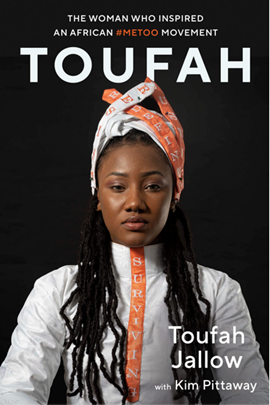
Toufah: The woman who inspired an African #MeToo movement By Toufah Jallow with Kim Pittaway, 2022, 320 pages, hardcover, paperback, e-book and audiobook, Random House Canada.


This story is an inspiring memoir from a courageous young African woman.  She was forced to flee her home country in The Gambia after being raped at the age of eighteen by the country’s dictator.  She became the first woman to publicly call the country’s dictator to account for sexual assault and in the process, launched a protest movement in West Africa.

In 2015, Toufah Jallow won the presidential competition designed to identify and support the country’s smart young women with a scholarship to study wherever they wanted.  However, winning the competition brought her to the attention of Yahya Jammeh, the country’s dictator.  He pretended to be fatherly and gave gifts to her and her family.  Then he proposed marriage.  Toufah refused so he drugged and raped her. 

She couldn’t tell anyone what happened.  She felt guilty.  So she planned a nerve-wracking escape to Sénégal and with help, hid in Dakar waiting for a country to accept her.  She wasn’t safe in Sénégal.  Jammeh was looking for her.  The situation was tense.  Then the International Organisation of Migration found a country willing to accept her.  She was going to Canada where she would be safe.  The Immigration Officer unrolled a map of Canada and asked her where she wanted to go.  She knew nothing about Canada.  The tension broke and I laughed and cried at the same time.  Compare the size of Canada to The Gambia and you will understand.

Interestingly, there is no word for rape in Wolof, Fulani and Mandinka, three indigenous languages spoken in The Gambia.  “When you do not have a word to describe a thing, to make it a crime, a reality,” speaking out makes a difference even in the absence of precise words.  And that’s what Toufah did.

A few years later, she contacted Human Rights Watch and was helped to go public giving press conferences.  She organised a women’s rights march, the first march of its kind in The Gambia.  Women could make themselves heard; they could teach women and girls about women’s rights and autonomy, in other words, the right to control their own bodies.  They marched wearing white T-shirts with “#IamToufah” on the front and carried signs declaring “No Means No”, “Our silence is their protection. Speak Up”, “No to Sexual Violence”, “Rape Destroys Human Dignity”, “No Woman Deserves Rape”.

And she established the Toufah Foundation to help victims of VAW and IPV.

Saturday, December 30, 2023

Know My Name: A Memoir by Chanel Miller, written in 2019


While Chanel tells the details of her experiences after learning she had been assaulted outside of a fraternity party at Stanford, we learn about the strength of a survivor who is trying to find her "normal" while awaiting trial. While this book is both heart-wrenching and courageous, Miller articulates the complexity of being an assault survivor with wit and charm. Both a writer and artist, Chanel pulls in the reader with her descriptions and details. She brings us with her as she recalls heartbreaking moments along her journey as "Emily Doe," and what life was like for her as she decided to share her identity with the country.

Her strength is awe-inspiring, and the way she articulates her perspectives is almost philosophical. While her assailant was only sentenced to 6 months in county jail (and only actually served 3), Miller struggles with shame and isolation. Throughout the book, readers are forced to reckon with our ideas of privilege, sexual predators, and the criminal justice system. Chanel is a leading writer of our time who will not only change the way you see our world, but also the way you may see yourself.

Submitted by Karen Archibee, Zonta Club of Oswego

Saturday, September 16, 2023

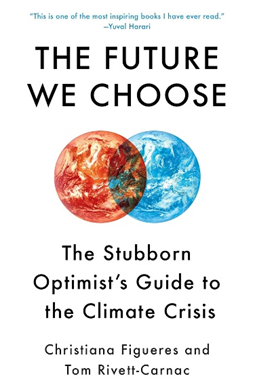
The Future We Choose: The Stubborn Optimist's Guide to the Climate Crisis by Christiana Figueres and Tom Rivett-Carnac


A cautionary but optimistic book about the world’s changing climate and the fate of humanity, from Christiana Figueres and Tom Rivett-Carnac—who led negotiations for the United Nations during the historic Paris Agreement of 2015.

The authors outline two possible scenarios for our planet. In one, they describe what life on Earth will be like by 2050 if we fail to meet the Paris Agreement’s climate targets. In the other, they lay out what it will be like to live in a regenerative world that has net-zero emissions. They argue for confronting the climate crisis head-on, with determination and optimism. The Future We Choose presents our options and tells us what governments, corporations, and each of us can, and must, do to fend off disaster. This book is available in both written and audio formats.


Sunday, January 15, 2023

Under the Skin: The Hidden Toll of Racism on American Lives and on the Health of Our Nation


by Linda Villarosa, 2022, 269 pages, hardback, e-book, and audiobook.

In this powerful, carefully researched book, journalist Linda Villarosa builds on her 2018 articles on mortality among Black mothers and infants to describe the significant health challenges faced by Black American simply because they are Black. She effectively combines articles from medical journals with personal accounts to paint  a convincing picture of how Black Americans “live sicker and die quicker” than their white counterparts, no matter their income or education.

She outlines three different reasons for the much poorer health outcomes among Black people:

·       Bias in the health care system leading to different treatment of Black and White patients

·       Environmental injustice which disproportionately exposes Black communities to pollution from highways, toxic waste dumps, and lead pipes and so on

·       “Weathering”—the chronic stress resulting from constantly coping with racism that can result in premature aging and poor health outcomes. 

She also asks the important question: “What if Black people are simply the canaries in the coal mine?” Does sustained discrimination cause harm to anyone, no matter their race? To help answer this question, she visits West Virginia, one of the whitest (93% white) and poorest states, with the lowest life expectancy in the nation.  She found that West Virginia is plagued by some of the same diseases that shorten the lives of Black Americans with poor physical and mental health.

Villarosa documents unending examples of social racism, inbred bias, and general neglect, but somehow remains hopeful for change, introducing individuals and programs that are making positive differences. Her compelling account clearly reveals that the American medical system must be reformed. A convincing must-read.


Tuesday, November 15, 2022

Roll Red Roll: Rape, Power, and Football in the American Heartland


by Nancy Schwartzman with Nora Zelevansky, 2022, 283 pages, hardback, e-book, and audiobook.  A documentary version was released in 2018.

In this compelling account, filmmaker Schwartzman focuses on an August 2012 high school party where several members of the Steubenville football team sexually assaulted an unconscious (drunk and possibly drugged) teenage girl, filmed the assault on their phones and live-tweeted about it.

Schwartzman spent three years in the town documenting the case and its consequences. She interviewed everyone involved, read police reports and trial transcripts, and viewed social media posts. She explored the role high school football played in this struggling rust belt town.

She clearly shows that rape culture (“boys will be boys), victim blaming, and institutional complicity are the rule rather than the exception in too many places. She believes that there has been progress in the ten years since the assault, but we still have far to go. “We have a chance to learn from our mistakes, call in a diversity of voices, and protect future generations. But first we have to be willing to take a hard look at the unconscious, entrenched behaviors that allow this type of culture to flourish.” A well-documented account of a crime without punishment as violence against women continues.

A related, excellent book is She Said by Jodi Kantor & Megan Twohey.


Wednesday, October 19, 2022

City of Refugees: The Story of Three Newcomers Who Breathed Life into a Dying American Town

 by Susan Hartman, 2022, 256 pages, hardback, e-book, and audiobook


In this engaging book, journalist Susan Hartman followed three refugee families living in Utica, New York for eight years.  She shows how the influx of refugees into Utica has helped revive this struggling upstate old manufacturing city.

In the 1970’s, the factories in Utica downsized then closed. Thousands of people lost their jobs. Utica’s population, which was 100,000 in 1960, dropped to 60,000 in 2000. The city’s economic decline led to gang violence, drug dealing, and frequent arson, but left behind plentiful and inexpensive housing.


The inexpensive housing provided homes for the refugee families, including the three Hartman profiled in this book:

·         Mersiha Omeragic, a refugee from Bosnia, runs a bakery business from her home, teaches English at the Mohawk Valley Resource Center for Refugees, and recently opened a café/bakery downtown.

·         Sadia, a Somali Bantu teen, arrived with her family from a Kenyan refugee camp. She struggles with her mother about Americanizing too fast and  tries to cope with the demands of an American high school.

·         Ali, an Iraqi with traumatic war experiences, returns to Iraq as a translator for the American army to provide for his family in Utica.


As their lives changed, so did the city of Utica. The population of the city is now 65,000 people, a quarter of which are refugees and their families. Downtown has been revitalized, including construction of a big new hospital and new apartment buildings. People are moving into the city, instead of moving out.


In this immersive study, Hartman illuminates the humanity of these outsiders, while demonstrating the crucial role immigrants play in the economy and society of America.


Sunday, August 21, 2022

Last Summer on State Street

 by Toya Wolfe, 2022, 212 pages, hardback, e-book, audiobook.


In this moving autobiographical novel, Toya Wolfe tells the story of 12-year-old Fe Fe (Felicia) and her friends Precious, Stacia, and Tonya during the summer of 1999. The Chicago Housing Authority is tearing down  the Robert Taylor Homes, the enormous public housing project where she lives with her mother and her older brother Meechie. Everyone will have to find a new place to live.

At the beginning of the novel, Fe Fe and her friends are still able to be children, double-dutching  (jumping rope) and spending time together. As destruction of their building approaches, tensions, and violence rise. It becomes impossible to ignore the poverty, drugs, police brutality, and gang warfare. Fe Fe must deal with  harsh realities around her--Meechie's unsuccessful struggle to resist gang life, Stacia's gang loyalty, and Tonya's mother's crack addiction. This is the story of how the children who live in these housing projects are forced to become adults too soon. As Fe Fe puts it, “Black kids don’t get the luxury of appearing childlike and innocent, that from the moment we are born, some people start a clock on how long it’ll take the boys to commit a crime, the girls to seduce.”

While Wolfe, who grew up in the Robert Taylor Homes, depicts the sadness of the characters’ lives, she also shows the power of love, faith, and close relationships to help some of them escape their grim world and build better lives.


Monday, May 16, 2022

WOMEN UNSILENCED: Our Refusal to Let Torturer-Traffickers Win

by Jeanne Sarson and Linda MacDonald

354 pages, Hardcover, Paperback,& Kindle.    Publication Date:  August 31,  2021


A review by Judith Ainsworth, Zonta Club of Ottawa

WOMEN UNSILENCED explores the impact of unthinkable violence committed against women and girls through many perspectives—women’s recall of life-threatening ordeals of torture, human trafficking, organized crime, society’s failure to recognize and address such crimes, and close examinations of how justice, health, political and social systems perpetuate re-victimizing trauma. At times raw, painful and shocking, this book is an important resource for those who have survived such crimes; professionals who support those victimized by torturers and traffickers; police, legal professionals, criminologists, human rights activists, and educators alike. It reveals how healing and claiming one’s relationship with/to/for Self is possible.


Jeanne Sarson and Linda MacDonald are retired public health nurses whose own experiences helped give voice and understanding to women who have been silenced. The book uses women’s storytelling to educate readers on the unimaginable layers of perpetrators’ modus operandi of violence, manipulation and deceit. They heard from other women who suffered torture when exploited in prostitution or pornographic violence. They defied social willingness to ignore that such violence existed by calling for non-State torture to be criminalised and they use their website www.nonstatetorture.org to promote global awareness.


Their ground-breaking work began in 1993, fifteen years before the United Nations Committee against Torture ventured to write, in 2008, that acts of torture committed by private individuals or groups are specific human rights violations. Back in 1993 they could find no literature on how to offer recovery care to women who survived such torture. They made it a goal to break this silence by detailing the intimacies of their recovery work journey offering care, hope and belief to women in WOMEN UNSILENCED.


They are often asked how two women—two nurses—who live in a little Canadian Nova Scotia town managed to achieve what they have. Their answer is simple: “We cared!”

Monday, April 18, 2022

Because of Sex: One Law, Ten Cases, and Fifty Years that Changed American Women's Lives at Work

 by Gillian Thomas, 2016, 295 pages, paperback, e-book, audiobook

An illuminating study of landmark sex-discrimination cases waged in the wake of Title VII of the 1964 Civil Rights Act which added three crucial words, "because of sex," to the employment discrimination section. This landmark piece of legislation for working women came at a time when job opportunities were few, career advancement was unheard of, and pregnancy and even marriage could bring about instantaneous unemployment.


Thomas, an employment discrimination lawyer, presents 10 cases that went all the way to the Supreme Court to illustrate the early efforts by working women to find some equality and justice in the workplace. These efforts included being able to be hired in jobs once the exclusive domain of men, being protected from sexual harassment, and protected from discrimination for pregnancy


In the years since, women have gone on to comprise almost half the country's work force while rising to the highest ranks in every profession. Yet those achievements weren't attained with the mere stroke of a pen. There were real women behind these accomplishments, women who had to sue for the freedoms that Title VII purported to have granted.


The author merges the personal stories with the legal intricacies of the litigation and crafts a moving and informative account of a struggle for equality that remains incomplete.

Sunday, March 20, 2022

Being Heumann: An Unrepentant Memoir of a Disability Rights Activist

By Judith Heumannwith Kristen Joiner, 2020

218 pages, paperback, e-book, and audiobook.

In this moving memoir, Judith Heumann shares the story of her life and her lifelong career as a disability advocate. One of the nearly 43,000 U.S. children affected by the 1949 polio epidemic, she is a paraplegic who has used a wheelchair since childhood. She had remarkable parents, German Jews orphaned by the Holocaust. They refused to institutionalize her as a toddler after her bout with polio and fought for her to get an education in the New York City public schools. They raised her to believe that she could do anything, despite being in a wheelchair. 

Until the 1980, disabled people were largely made invisible, with no easy means of access to the systems of education, transportation, employment, and other things that most people took for granted.


Starting with a successful lawsuit in 1970 to gain a New York City teaching license; then leading the 1977 24-day sit-in of the office of Health, Education, and Welfare in San Francisco demanding the enforcement of Section 504 of the Rehabilitation Act, which prohibited exclusion of anyone from a program that received federal funds; and finally achieving the passage of the American with Disabilities Act in 1990, Judith Heumann played a major role in the struggle to ensure that people with disabilities are treated like everyone else.

She ends her memoir with this inspiring message: ” Change never happens at the pace we think it should. It happens over years of people joining together, strategizing, sharing, and pulling all the levers they possible can. Gradually, excruciatingly slowly, things start to happen, and then suddenly, seemingly out of the blue, something will tip.”

Thursday, February 17, 2022

The Pearl That Broke Its Shell, by Nadia Hashimi


452 pages, Kindle, paperback or hard cover,

Published 2014


A Review,  by Siobhan O’Hora

This book was recommended to me by my former boss.  She knows how passionate I am about women’s issues and she thought that I would appreciate the nature of this story.  Although this is fiction, it is not hard to imagine the many truths that unfold in the telling of this story.


Rahima and her sisters live in Afghanistan.  Their mother is condemned by her in-laws for only bearing female children and her father is an opium-addicted fighter for a wealthy man who is involved in both the drug trade and politics. Rahima and her sisters only sporadically attend school at the whim of her father and they are very limited in their freedoms because they were born girls.  At 9 years old, Rahima’s mother decides that they are going to invoke the ancient custom of bacha posh.  They cut Rahima’s hair short, dress her in male clothing, and start calling her Rahim.  In essence, making her a boy.  In this transformation, Rahim can then attend school, run and play football with the other boys in the village, freely leave the house to run errands for “his” mother, and even get a small job to help support the family.  In this custom, families with only girls can alter the looks of one of their daughters to be that of a male until they transform back into a girl when she is of marriageable age.


Rahim was not the first one in her family to go through the process of bacha posh.  Her aunt would visit her family and share bits and pieces of the story of their great, great grandmother Shakiba who had also been a girl-boy due to the circumstances of her young life.  Rahim(a) grows up listening to stories about her great great grandmother and over the course of time takes strength from Shakiba’s life story and struggles.


This is a story set in somewhat current Afghanistan as it shares the story of Rakima and how her life in some ways mirrors the life of Shakiba a century earlier.  It is the story of what the life of a girl in Afghanistan is like…the lack of freedom, the abuse, the poverty, the patriarchal rule, early childhood marriage and enslavement.  


As a member of Zonta I was immediately drawn to the plights of both Shakiba and Rahima.  Not only because of the injustices they and other women faced throughout the novel, but because I know that women living in Afghanistan are still living with these struggles to this day.  This is even more pronounced now that the Taliban is back in control of the country.  I felt this book helped me to understand some of the history and culture of this nation.  It touched on familial rules as well as what it was like to live in a male run village, a country under a Shah and how women’s roles have changed over time, yet have still remained somewhat the same.  


I highly recommend this book as a view into the country and culture of Afghanistan and how women are viewed and treated there.


Monday, January 17, 2022

Maid: Hard Work, Low Pay, and a Mother's Will to Survive, by Stephanie Land

2020 - Paperback, Hardcover, and Audiobook   288 Pages

A Review, by guest contributor Jacqueline Wallace, member of the Zonta Club of Oswego.

Stephanie Land's 2020 New York Times best seller autobiography "Maid: Hard Work, Low Pay and a Mother's Will to Survive," provides a voice to many who are trying to find their way while struggling below the poverty line. 

The book showcases Land's first-hand experiences of working hard as a single mom in the service industry for little pay while navigating the system and surviving domestic violence. 

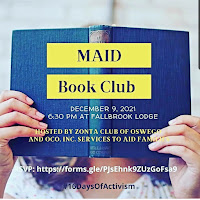
Many domestic violence agencies, such as Oswego's OCO inc. Sevices to Aid Families, have hosted discussions on Land's book as a way to shed light on domestic violence and services available for survivors and their families.

The book even caught the eye of former President Barack Obama, and appeared on his Summer Reading List.  He had this to say about it, "A single mother's personal, unflinching look at America's class divide, a description of the tightrope many families walk just to get by, and a reminder of the dignity of all work."

Netflix has even launched  seven-part series adapted from Stephanie Land's bestselling memoir.  While Maid is based on Land's experiences, it's reminiscent of many people's stories, which the series acknowledges with other characters Alex meets.  It’s no surprise that Land’s modest, straightforward book, with its nuts-and-bolts account of the housecleaning work she took on to support herself and her daughter, has been radically transformed in the Netflix series— only the broadest outlines of her story, along with the usual smattering of arresting or convenient details, have been retained. 
Oswego Club hosted a review

Members of the Zonta Club of Oswego hosted "Maid Book Club: Impact & Resources in our Local Community" with OCO Inc's Services to Aid Families on December 9 as part of Zonta's 16 Days of Activism. The event was facilitated by professionals from OCO, Inc.'s Services to Aid Families

Thursday, December 16, 2021

Walk with me: a Biography of Fannie Lou Hamer by Kate Clifford Larson

 2021, 322 pages, hardback, e-book.

Kate Clifford Larson explores the life of Mississippi sharecropper and civil rights activist Fannie Lou Hamer in this outstanding book that takes readers on the journey of a woman who was born into the grinding poverty and racism of the Mississippi Delta, and who rose to become the voice of the unheard and the conscience of a nation.

The 20th child of Mississippi sharecroppers, she had to quit school to work in the fields after sixth grade. When she tried to register to vote she was fired from her plantation job and kicked out of the house where she lived. Despite being arrested, brutally beaten, harassed by lawmen and the KKK, she persisted. Fannie Lou Hamer lifted up her voice!

Starting in the early 1960s and until her death in 1977, she was an irresistible force, not merely joining the swelling wave of change brought by civil rights but keeping it in motion. Working with the Student Non-Violent Coordinating Committee (SNCC), which recruited her to help with voter-registration drives, Hamer became a community organizer, women's rights activist, and co-founder of the Mississippi Freedom Democratic Party. She summoned and used what she had against the citadelher anger, her courage, her faith in the Bible, and her conviction that hearts could be won over and injustice overcome. She used her brutal beating at the hands of Mississippi police, an ordeal from which she never fully recovered, as the basis of a televised speech at the 1964 Democratic Convention, a speech that the mainstream partyincluding itsstandard-bearer, President Lyndon Johnsontried to contain. But Fannie Lou Hamer would not be held back. For those whose lives she touched and transformed, for those who heard and followed her voice, she was the embodiment of protest, perseverance, and, most of all, the potential for revolutionary change.

She was not well educated or a polished orator like many of her fellow activists, but her ability to empathize with the poorest Black men and women, long denied the ability to vote in the South, resonated profoundly throughout the region and rendered her one of the most effective speakers of all.

Hamer's big moment came as she told her life story on national TV as part of the effort to challenge Mississippi's all-White delegation to participate in the Democratic National Convention in 1964.  Her testimony, given while wearing a borrowed dress, eloquently described the oppressive system that kept Mississippi Blacks powerless, and poverty stricken. The group won the right to seat Black delegates at the 1968 convention, and Hamer even ran for office herself.

This very moving book raises important questions about leadership of social movements—should it be top-down, led by ‘elites’, should it be grassroots bottom-up led by ‘the people’ or a combination. A significant question we have yet to answer.

Saturday, November 20, 2021

Girl Waits with Gun, by Amy Stewart

"Girl Waits with Gun makes excellent use of history to put a fresh spin on classic cop-and-crook types. Amy Stewart s true-life protagonist is a rough and tumble version of the early twentieth century s New Woman. She is witty, sharply drawn, and suffers no fools! Suzanne Rindell, author of The Other Typist"  Google Books

Girl Waits With Gun is the 1st book in the Kopp Sisters series by NYT best-selling American author, Amy Stewart.   Fiction - 2015, 448 pages, paperback, audiobook, and e-book.  


Constance Kopp doesn’t quite fit the mold. She towers over most men, has no interest in marriage or domestic affairs, and has been isolated from the world since a family secret sent her and her sisters into hiding fifteen years ago. One day a belligerent and powerful silk factory owner runs down their buggy, and a dispute over damages turns into a war of bricks, bullets, and threats as he unleashes his gang on their family farm. When the sheriff enlists her help in convicting the men, Constance is forced to confront her past and defend her family — and she does it in a way that few women of 1914 would have dared. A fun book that touches on serious issues.


Saturday, November 6, 2021

Gendered Citizenship. The Original Conflict over the Equal Rights Amendment, 1920–1963, by Rebecca DeWolf

(350 Pages, published October 2021)


Want to understand the ERA better? 

By engaging deeply with American legal and political history as well as the increasingly rich material on gender history, Gendered Citizenship illuminates the ideological contours of the original struggle over the Equal Rights Amendment (ERA) from 1920 to 1963. A comprehensive, full-length history of that struggle, this book grapples not only with the battle over women's constitutional status but also with the more than forty-year mission to articulate the boundaries of what it means to be an American citizen. DeWolf explores how this conflict around the ERA ultimately became the defining narrative for the changing nature of American citizenship in the era.

"This changes the game, in terms of what we have at our disposal now to talk about the forces that have historically supported or rejected not only the ERA but the ideological positions that coalesce to support or reject the ERA...the book is important because it is an original way of looking at a topic that many folks think has been fully covered, but DeWolf’s book proves has been missing major pieces. The attention paid to this particular historical time period, and the particular lens of looking at the topic from the vantage point of emancipationism and protectionism, is extremely valuable as a contribution to the field. It is meticulously historically researched, using relevant primary source archives, and appropriate secondary sources where needed."  LAURA D'AMORE

Rebecca DeWolf is a writer and a historian with a PhD in American history. Her research has won recognition through grants and fellowships, including the Dirksen Congressional Research Grant. Her articles have appeared in the Washington Post, Frontiers, and New America Weekly.

read more about Rebecca DeWolf here:  https://www.rebeccadewolf.com/about-me


Monday, October 18, 2021

Three girls from Bronzeville: A Uniquely American Memoir of Race, Fate, and Sisterhood, by Dawn Turner

Review submitted by Joanne Shawhan, Zonta Club of Alban


Three girls from Bronzeville: A Uniquely American Memoir of Race, Fate, and Sisterhood by Dawn Turner, 2021, 320 pages, hardback, e-book, and audiobook.

In this memoir, journalist and novelist, Dawn Turner delivers an immersive and often heartbreaking portrait of life in the historic Bronzeville section of Chicago.  It offers a penetrating exploration of race, opportunity, friendship, sisterhood, and the powerful forces at work that allow some to flourish…and others to falter.

 They were three Black girls:  Dawn, her sister, Kim, younger by three years, and her best friend, Debra who roamed together the concrete landscape of Bronzeville, a historic neighborhood on Chicago’s South Side.  For a brief, wondrous moment the girls are all giggles and dreams and promises of “friends forever.” And then fate intervenes, first slowly and then dramatically, sending them careening in wildly different directions. There’s heartbreak, loss, displacement, and even murder. Dawn struggles to make sense of the shocking turns that consume her sister and her best friend, all the while asking herself a simple but profound question: Why? 

It’s at once a celebration of sisterhood and friendship, a testimony to the unique struggles of Black women, and a tour-de-force about the complex interplay of race, class, and opportunity, and how those forces shape our lives and our capacity for resilience and redemption.

Thursday, September 23, 2021

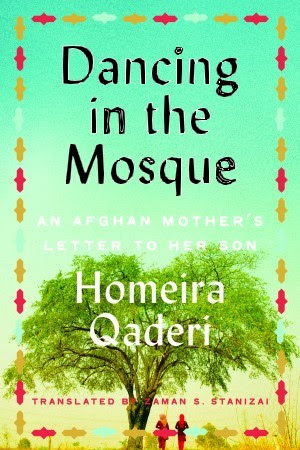
Dancing in the Mosque: An Afghan Mother's Letter to Her Son Book, by Homeira Qaderi

Publisher Harper Collins, December 1, 2020  

A book review, by Irene Orton

An exquisite and inspiring memoir about one mother’s unimaginable choice in the face of oppression and abuse in Taliban-controlled Afghanistan.

Time to share with everyone this great book that I just finished.  The title is:  Dancing in the Mosque by Homeira Qaden.  With all that is happening in Afghanistan I felt compelled to pick up this book in my local library.  I was not disappointed.


This 212 page book was compelling, as a courageous mother in Afghanistan she writes this memoir about the love she has for this child in a country that shuts women away from everything that we hold true and dear here in the United States.  I learned so much about society and the treatment of women in this country.  Homeira was no ordinary women, and she was constantly fighting for the rights of women in a very theocratic and patriarchal society.  At 13, she risked her freedom, and she defied the law to teach reading and writing to children.


This memoir is a letter to her son whom she was forced to leave behind.  This books serves as a wonderful invitation to reflect on the meaning of motherhood, sacrifice, and survival.  How far would we go to protect ourselves, our families and our dignity?


I could not put this book down!!!

Wednesday, August 11, 2021

THE GIRLS IN THE WILD FIG TREE HOW I FOUGHT TO SAVE MYSELF, MY SISTER, AND THOUSANDS OF GIRLS WORLDWIDE, by Nice Nailantei Leng'ete

(Written BY NICE LENG'ETE WITH ELIZABETH BUTLER-WITTER)  

 RELEASE DATE: SEPT. 14, 2021


Review by - https://www.kirkusreviews.com

An inspirational memoir from a human rights activist who has devoted her life to fighting female genital mutilation.

The author is a member of the Maasai tribe, born in the small Kenyan town of Kimana, and she evocatively explores the culture of her people. Historically, Maasai men are known as fierce warriors who protect their people and animals, while Maasai women serve as the caregivers of the house and children. A community bound by tradition, they live in hand-built circular homes and raise cattle as the primary food source. 


When they are young, children have one of their cheeks branded by a hot coil of wire; the scab creates a circle that serves as “a special symbol to mark us as Maasai.” When it was Leng’ete’s turn, she ran away, and she “still [has] no marks.” Another tradition is referred to as “the cut.” During this ceremony, the women subject the young females to a procedure in which their clitoris is either cut or removed completely—without anesthesia. 

Leng’ete refused to undergo FGM. “I loved my family. I loved my people. But this, I thought, was wrong,” she explains. “Tradition can be good. Tradition can be beautiful. But some traditions deserve to die.” Following her defiant act, she was shunned. With urgent, shocking, and heartbreaking detail, Leng’ete brings readers into her life. Beginning her work with the African Medical and Research Foundation when she was still a teenager, she found her calling. Armed with scientific evidence about the significant health risks associated with FGM, Leng’ete returned to her community in hopes of instilling change. Due in part to her relentless efforts, tribal leaders “changed the Maasai constitution to reflect our commitment to end FGM.” Leng’ete was also awarded the black walking stick, a symbol of leadership not normally given to women. She went on to campaign globally, including building A Nice Place in Kimana, “a safe haven for girls fleeing FGM."

An incredibly powerful story that offers real hope for the future.

Monday, July 5, 2021

Minor Feelings: an Asian American Reckoning

by Cathy Park Hong, 2020, 206 pages, paperback.

The poetry editor of the New Republic discusses her experiences living and working in a culture hostile to expressions of Asian individuality and identity. In this memoir in essays, Hong offers a fierce and timely meditation on race and gender issues from her perspective as a Korean American woman. Candid and unapologetically political, Hong's text deftly explores the explosive emotions surrounding race in ways sure to impact the discourse surrounding Asian identity as well as race and belonging in America.
 

You Don't Belong Here: How Three Women Rewrote the Story of War

 by Elizabeth Becker, 2021, 289 pages. Hardback.


An incisive history of the Vietnam War via the groundbreaking accomplishments of three remarkable women journalists. In this work, Elizabeth Becker, focuses on the careers of Frances FitzGerald, Kate Webb, and Catherine Leroy, interweaving their stories as they traveled to Vietnam in the mid-1960s. As U.S. involvement was escalating and news organizations continued to send men to chronicle the war, these women paid their own ways and sought out freelance reporting opportunities. "Leroy, FitzGerald, and Webb were the three pioneers who changed how the story of war was told," writes Becker. "They were excluded by nature from the confines of male journalism, with all its presumptions and easy jingoism. They saw the war differently and wrote about it in wholly new ways.”